







Market Highlight 21.07.2026
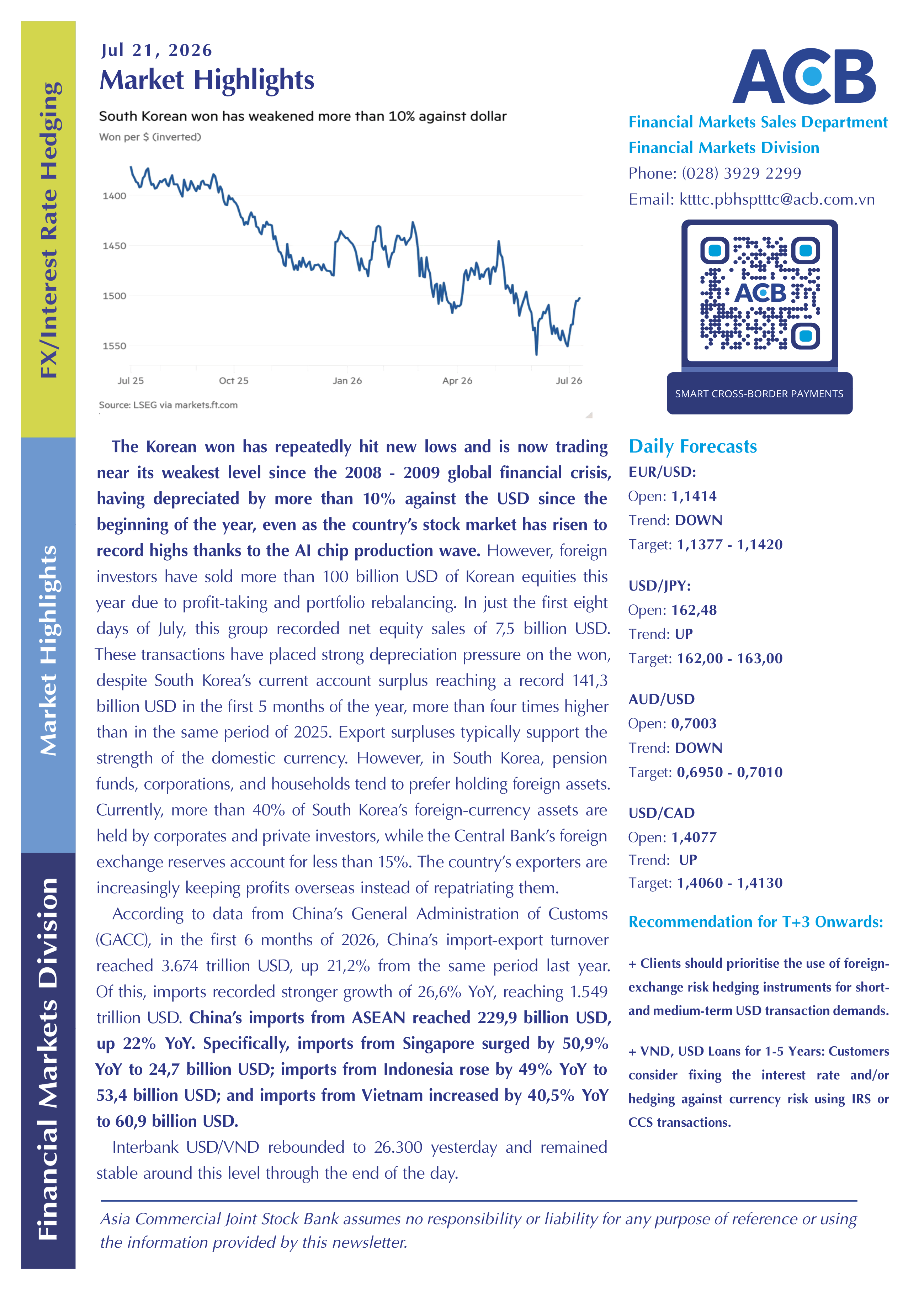
The Korean won has repeatedly hit new lows and is now trading near its weakest level since the 2008 - 2009 global financial crisis, having depreciated by more than 10% against the USD since the beginning of the year, even as the country’s stock market has risen to record highs thanks to the AI chip production wave. However, foreign investors have sold more than 100 billion USD of Korean equities this year due to profit-taking and portfolio rebalancing. In just the first eight days of July, this group recorded net equity sales of 7,5 billion USD. These transactions have placed strong depreciation pressure on the won, despite South Korea’s current account surplus reaching a record 141,3 billion USD in the first 5 months of the year, more than four times higher than in the same period of 2025. Export surpluses typically support the strength of the domestic currency. However, in South Korea, pension funds, corporations, and households tend to prefer holding foreign assets. Currently, more than 40% of South Korea’s foreign-currency assets are held by corporates and private investors, while the Central Bank’s foreign exchange reserves account for less than 15%. The country’s exporters are increasingly keeping profits overseas instead of repatriating them.
According to data from China’s General Administration of Customs (GACC), in the first 6 months of 2026, China’s import-export turnover reached 3.674 trillion USD, up 21,2% from the same period last year. Of this, imports recorded stronger growth of 26,6% YoY, reaching 1.549 trillion USD. China’s imports from ASEAN reached 229,9 billion USD, up 22% YoY. Specifically, imports from Singapore surged by 50,9% YoY to 24,7 billion USD; imports from Indonesia rose by 49% YoY to 53,4 billion USD; and imports from Vietnam increased by 40,5% YoY to 60,9 billion USD.
Interbank USD/VND rebounded to 26.300 yesterday and remained stable around this level through the end of the day.
Please contact the nearest Asia Commercial Joint Stock Bank's branch to receive information and consultancy if you are in need of making any foreign exchange and derivatives transactions.
Asia Commercial Joint Stock Bank assumes no responsibility or liability for any purpose of reference or using the information provided by this newsletter.
Directly contact us to receive market news and consultancy on foreign exchange products and derivatives:
- Financial Markets Division – Email: ktttc@acb.com.vn ; or
- Mr. Khanh Hoang (Financial Markets Senior Analyst) – Email: hoangnk@acb.com.vn