







Market Highlight 17.07.2026
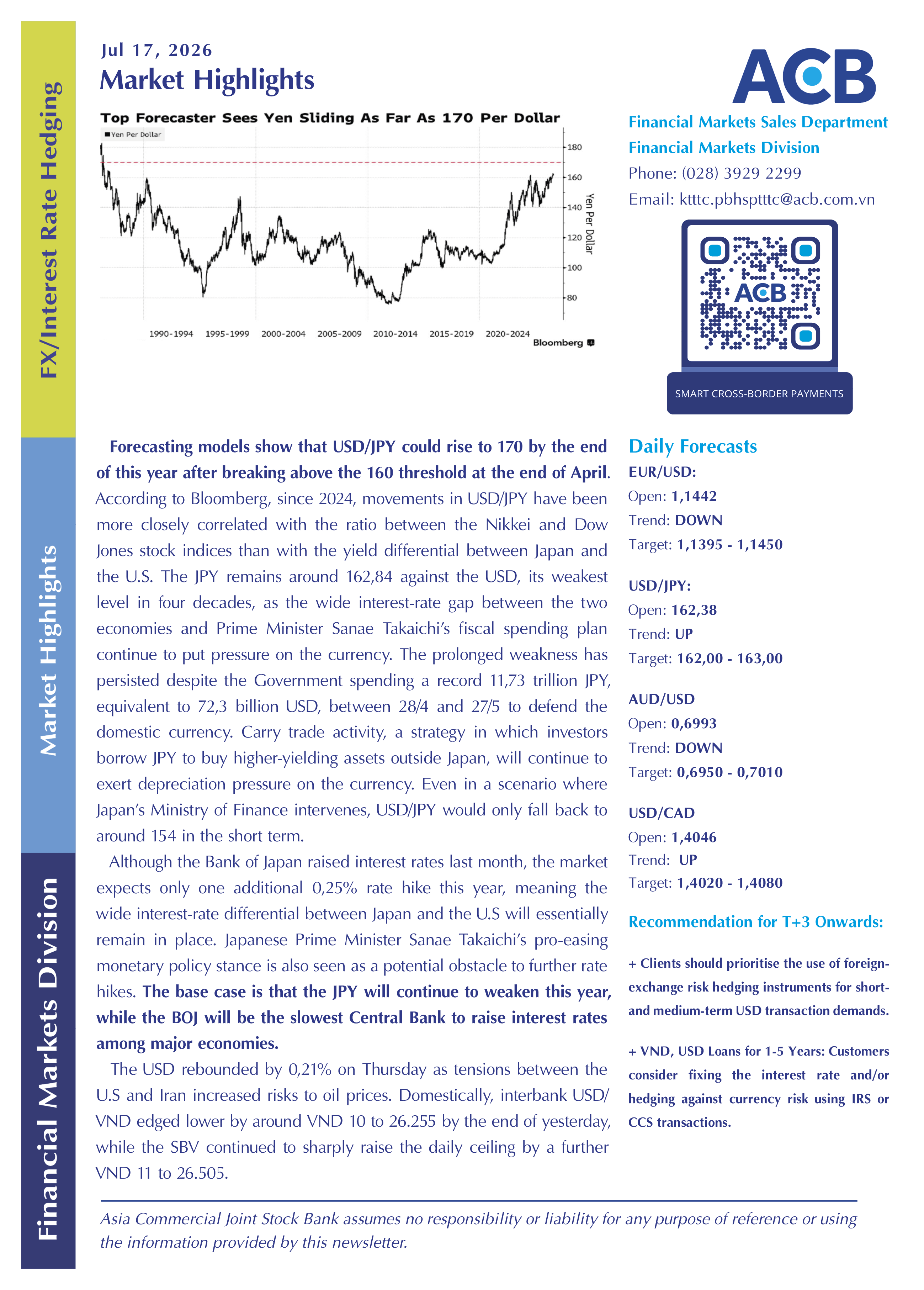
Forecasting models show that USD/JPY could rise to 170 by the end of this year after breaking above the 160 threshold at the end of April. According to Bloomberg, since 2024, movements in USD/JPY have been more closely correlated with the ratio between the Nikkei and Dow Jones stock indices than with the yield differential between Japan and the U.S. The JPY remains around 162,84 against the USD, its weakest level in four decades, as the wide interest-rate gap between the two economies and Prime Minister Sanae Takaichi’s fiscal spending plan continue to put pressure on the currency. The prolonged weakness has persisted despite the Government spending a record 11,73 trillion JPY, equivalent to 72,3 billion USD, between 28/4 and 27/5 to defend the domestic currency. Carry trade activity, a strategy in which investors borrow JPY to buy higher-yielding assets outside Japan, will continue to exert depreciation pressure on the currency. Even in a scenario where Japan’s Ministry of Finance intervenes, USD/JPY would only fall back to around 154 in the short term.
Although the Bank of Japan raised interest rates last month, the market expects only one additional 0,25% rate hike this year, meaning the wide interest-rate differential between Japan and the U.S will essentially remain in place. Japanese Prime Minister Sanae Takaichi’s pro-easing monetary policy stance is also seen as a potential obstacle to further rate hikes. The base case is that the JPY will continue to weaken this year, while the BOJ will be the slowest Central Bank to raise interest rates among major economies.
The USD rebounded by 0,21% on Thursday as tensions between the U.S and Iran increased risks to oil prices. Domestically, interbank USD/VND edged lower by around VND 10 to 26.255 by the end of yesterday, while the SBV continued to sharply raise the daily ceiling by a further VND 11 to 26.505.
Please contact the nearest Asia Commercial Joint Stock Bank's branch to receive information and consultancy if you are in need of making any foreign exchange and derivatives transactions.
Asia Commercial Joint Stock Bank assumes no responsibility or liability for any purpose of reference or using the information provided by this newsletter.
Directly contact us to receive market news and consultancy on foreign exchange products and derivatives:
- Financial Markets Division – Email: ktttc@acb.com.vn ; or
- Mr. Khanh Hoang (Financial Markets Senior Analyst) – Email: hoangnk@acb.com.vn